
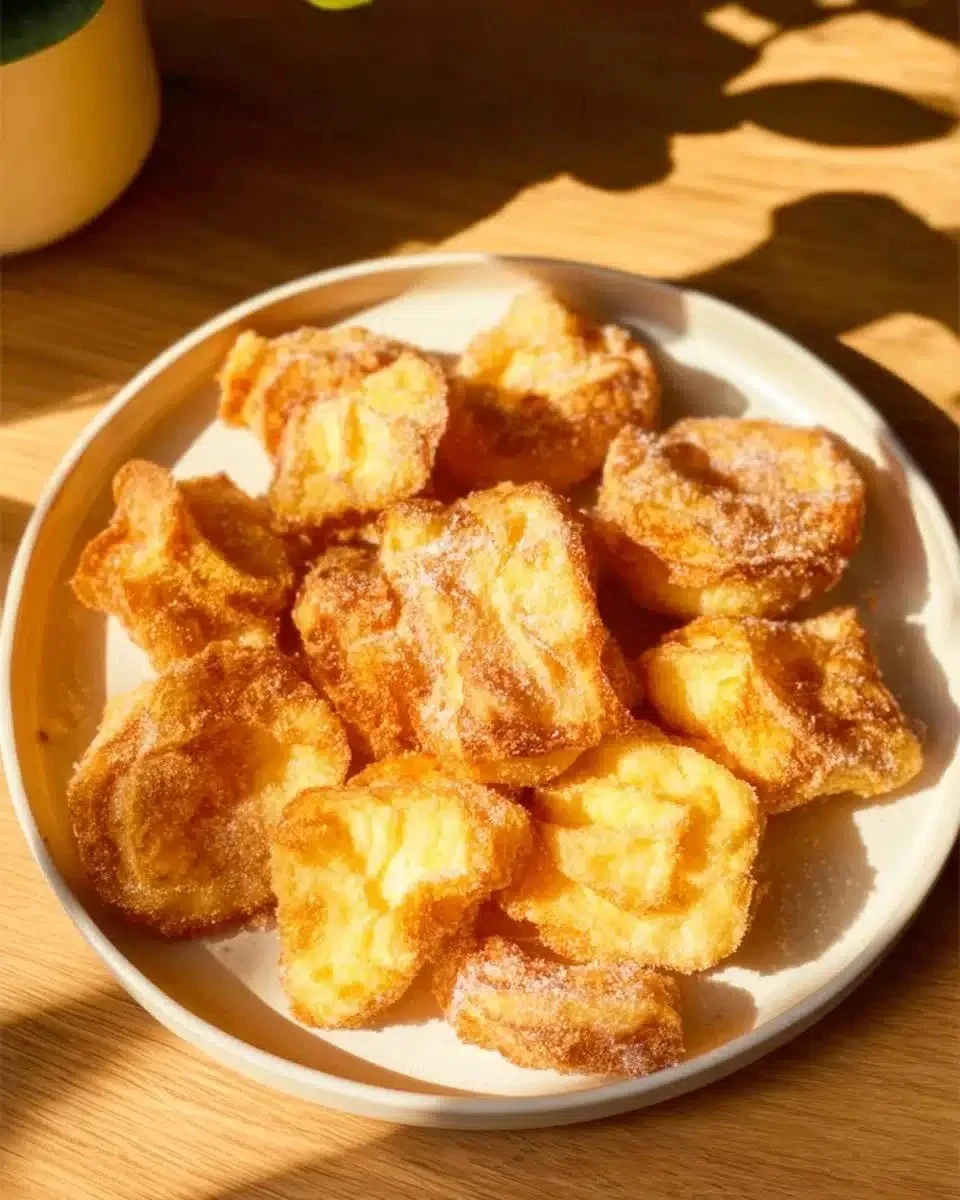
Fried Milk Recipe — Crispy Spanish Custard
The first bite should crack through a thin, caramelized shell and reveal a pillowy, custard center — this fried milk recipe delivers that contrast. Originating in Spain as leche frita, this dessert is a small piece of fried comfort: lightly sweet, cinnamon-scented, and addictive when still warm. After testing this version eight times across different stovetops and pans, I settled on the milk-to-starch ratio and coating method that give the cleanest cut and the crispiest fry. I developed it while staging in a Spanish pastry kitchen, and this is the version I perfected there. Read on for exact measurements, precise timings, and simple tricks to get restaurant-quality leche frita at home. If you love custard treats, compare textures with a custard rasgulla recipe to see how different cultures celebrate silky centers and syrupy finishes.
Why This Recipe Works
- Thickening with cornstarch creates a clean, sliceable custard that holds its shape when fried.
- Simmering the milk with lemon peel and cinnamon infuses aroma without adding liquid or bitterness.
- Chilling fully (at least 2 hours) firms the custard so cuts are sharp and fry oil isn’t absorbed.
- A three-step coating (flour → egg → fine breadcrumbs) gives a stable, even crust that browns quickly.
- Quick, medium-hot frying (175°C / 350°F) seals the crust fast, keeping the interior silky, not greasy.
Ingredients Breakdown
- Whole milk — 1,000 ml (4 cups): Provides the silky base. Don’t use low-fat milk; it yields a thinner set.
- Granulated sugar — 100 g (1/2 cup): Sweetens the custard. Increase by 15–25 g for a sweeter finish.
- Cornstarch (cornflour) — 100 g (3/4 cup + 2 tbsp): The setting agent; measure by weight for consistency. Do not swap with flour 1:1 — cornstarch gives a cleaner, silkier set.
- Egg yolks — 3 large (about 55 g total): Enrich the custard and improve mouthfeel.
- Unsalted butter — 25 g (1 3/4 tbsp): Adds shine and richness at the end of cooking.
- Lemon zest (strip) — peel from 1 lemon: Adds bright perfume. Remove the peel before chilling.
- Cinnamon stick — 1: Simmered with the milk for warm spice. Remove before thickening.
- Vanilla extract — 1 tsp (5 ml): Finishing flavor. Add after cooking.
- All-purpose flour — 80 g (2/3 cup): For initial dredge. If using Diamond Crystal kosher salt in other steps, adjust accordingly.
- Large eggs for dredging — 2, beaten: For binding the breadcrumbs.
- Fine breadcrumbs or panko — 150 g (1 1/2 cups): Panko gives extra crunch; fine breadcrumbs give a more even crust.
- Neutral frying oil (vegetable, sunflower) — ~1.2 L (for a 20–25 cm / 8–10 in pot, depth ~4 cm): Maintain steady 175°C (350°F).
Substitutions with trade-offs:
- Dairy-free: Use full-fat canned coconut milk (shake can), but the flavor will be coconut-forward and the set slightly softer.
- Gluten-free: Use a 1:1 gluten-free flour in the dredge and GF breadcrumbs; texture will be slightly friable.
- Lower sugar: Reduce sugar to 80 g (1/3 cup + 1 tbsp), but the crust will brown less and overall taste less sweet.
Essential Equipment
- Medium saucepan (2–3 L): For cooking the milk mixture; heavy bottom prevents scorching.
- Whisk and heatproof spatula: Whisk to dissolve cornstarch; spatula to scrape the base without scratching.
- Shallow loaf pan or rimmed baking sheet (20 x 11 cm / 8 x 4.5 in) lined with plastic wrap: Pour custard to an even thickness for neat slicing.
- Deep, heavy pot or deep fryer: Use for frying; a heavy pot holds temperature better than a thin pan.
- Candy/deep-fry thermometer: Keeps oil at the correct 175°C (350°F). If you don’t have one, test with a small breadcrumb — it should sizzle and brown in ~30 seconds.
- Slotted spoon or spider: For safe transfer of pieces from oil to paper towel.
- Cooling rack over a sheet tray: Drain and keep crust crisp.
- Knife and ruler (optional): For precise 3–4 cm / 1–1.5 in squares.
If you don’t have a shallow loaf pan, use a rimmed baking sheet and spread mixture to 2–3 cm (3/4–1 in) thickness; freezing time may be slightly shorter.
Step-by-Step Instructions
Serves 6 · Prep 20 minutes · Cook 15 minutes · Inactive time 2 hours chilling · Total time 2 hours 35 minutes.
Step 1: Infuse the milk
Combine 1,000 ml (4 cups) whole milk, 1 cinnamon stick, and the strip of 1 lemon peel in a medium saucepan. Bring to a gentle simmer over medium heat, about 6–8 minutes, stirring occasionally to prevent skin forming. Remove from heat, cover, and steep for 10 minutes; discard the cinnamon stick and peel.
Step 2: Whisk dry to wet
In a bowl, whisk 100 g (1/2 cup) granulated sugar with 100 g (3/4 cup + 2 tbsp) cornstarch and 3 egg yolks until smooth, about 1 minute. Temper the mixture by whisking in 120 ml (1/2 cup) of the warm milk until smooth.
Step 3: Cook the custard
Return the tempered mixture to the saucepan, then whisk in the remaining milk. Cook over medium-low heat, whisking constantly, until the mixture thickens and comes to a gentle bubble, about 4–6 minutes. Do not stop whisking — this prevents lumps and scorching. The custard should look glossy and hold a spoon’s weight.
Step 4: Finish and chill
Off the heat, stir in 25 g (1 3/4 tbsp) unsalted butter and 1 tsp (5 ml) vanilla extract. Pour the custard into a lined shallow loaf pan and smooth to an even 2–3 cm (3/4–1 in) thickness. Cover with plastic wrap directly on the surface to prevent a skin and chill until firm, at least 2 hours or up to overnight.
Step 5: Cut and coat
Turn the chilled custard onto a cutting board and slice into 12 squares (for 6 servings, two pieces each) or desired shapes using a sharp knife. Set up a dredging station: 80 g (2/3 cup) all-purpose flour, 2 beaten eggs, and 150 g (1 1/2 cups) fine breadcrumbs. Dredge each piece in flour, then egg, then breadcrumbs, pressing gently to adhere. Rest on a tray for 10 minutes to help the coating set.
Step 6: Fry until golden
Heat oil in a heavy pot to 175°C (350°F). Fry pieces in batches for 1–2 minutes per side, turning once, until golden brown and crisp — the interior will remain cool but silky. Drain on a cooling rack set over a sheet tray.
Step 7: Finish and serve
Dust hot pieces with a mixture of 1 tbsp (12 g) granulated sugar and 1 tsp (2 g) ground cinnamon, or sprinkle with powdered sugar. Serve warm with a spoonful of citrus jam or a scoop of cinnamon ice cream.
Expert Tips & Pro Techniques
- Common mistake: frying too cool or too hot. If oil is under 170°C (338°F), pieces absorb oil and become greasy; over 180°C (356°F) and the crust burns before it heats through. Use a thermometer.
- For the cleanest cut, chill the custard until it’s rock-solid (overnight) and use a hot, dry knife between cuts for smoother edges.
- Make-ahead: You can make the custard up to 48 hours in advance, store covered in the refrigerator, then slice and coat just before frying.
- Pro trick for an even set: once the custard has thickened on the stove, transfer to a flat surface and spread immediately to target thickness — this prevents pockets of overcooked bits.
- Breadcrumb note: panko gives a lighter crunch; blitz panko briefly in a food processor for a finer, newspaper-like coating that browns evenly.
- Eggless coating option: use aquafaba (chickpea water) whipped lightly as a binder for a vegan-friendly crust, but expect slightly less color and a softer crust.
Storage & Reheating
- Refrigerator: Store cooled, fried pieces in an airtight container for up to 3 days. Place a paper towel under them to absorb any residual oil.
- Freezer: Fried pieces can be frozen up to 1 month on a sheet tray, then transferred to a freezer bag. Reheat from frozen in a 175°C (350°F) oven for 12–15 minutes. For best texture, freeze the un-fried, breaded custard squares on a tray until firm (1–2 hours), then bag; fry from partially thawed (about 15 minutes at room temp).
- Reheating: Reheat in a 175°C (350°F) oven for 8–10 minutes to restore crispness. Avoid microwaving — it softens the crust and ruins the texture.
Variations & Substitutions
- Gluten-Free Version: Replace all-purpose flour with a 1:1 gluten-free blend (such as Bob’s Red Mill) and use gluten-free breadcrumbs. Frying temperature and time remain the same.
- Coconut Leche Frita (Dairy-Free): Use 1 L full-fat canned coconut milk and replace butter with 1 tbsp coconut oil. The custard will be richer and carry coconut flavor; chilling time is the same.
- Orange & Cinnamon: Swap lemon peel for an orange peel and add 1/2 tsp grated fresh nutmeg. Flavor balance remains; no timing changes.
- Chocolate-dusted: Mix 2 tbsp unsweetened cocoa powder into the breadcrumbs for a subtle chocolate crust — color and crispness are unchanged.
- Low-Sugar: Reduce granulated sugar in custard to 80 g (1/3 cup + 1 tbsp) and increase coating sugar-dust to taste; custard sets the same but is less sweet inside.
Serving Suggestions & Pairings
- Serve with a scoop of cinnamon or vanilla ice cream and a drizzle of caramel.
- Pair with an aromatic coffee or sweet Spanish sherry; these contrast the fried sweetness nicely. For a bright counterpoint, try a cold citrus soda like a lemon-lime fizz recipe.
- Garnish with preserved citrus or a spoonful of orange marmalade for texture contrast.
- For a brunch twist, serve alongside fruit and espresso — the custard is a great sweet end for a Spanish-style spread; see more easy summer recipes to round the menu.
Nutrition Information
Per serving (serving size: 2 pieces; recipe yields 6 servings)
- Calories: 320 kcal
- Total Fat: 13 g
- Saturated Fat: 7 g
- Cholesterol: 125 mg
- Sodium: 120 mg
- Total Carbohydrates: 40 g
- Dietary Fiber: 0.5 g
- Sugars: 25 g
- Protein: 6 g
Nutrition values are estimates. Actual values may vary based on specific ingredients and preparation methods.
Frequently Asked Questions
Q: Why did my fried milk turn out runny?
A: Usually undercooked custard or too little cornstarch. Make sure the custard thickens on the stove to a glossy, pudding-like consistency and that you used 100 g cornstarch. Chill fully before cutting.
Q: Can I make this without eggs for coating?
A: Yes. Try aquafaba (chickpea liquid) lightly whipped as a binder, but expect a softer, less golden crust. Alternatively, skip breadcrumbs and dust well with flour before frying; color will be paler.
Q: Can I double this recipe?
A: Yes. Double all ingredients and use a larger pan or two pans so the custard spreads in an even, shallow layer. Chill time is the same, though cooling a larger mass may take slightly longer.
Q: Can I prepare this the night before?
A: Absolutely. Make the custard and chill overnight. Slice and coat just before frying for the freshest crust. Coated pieces can rest 10–30 minutes before frying.
Q: How long does this keep in the fridge?
A: Fried pieces keep well for up to 3 days in an airtight container. For the best texture, reheat in the oven to revive the crispness.
Q: Why did my crust fall off while frying?
A: Common causes are insufficient chilling, wet coating station, or oil that’s too hot. Rest coated pieces 10 minutes before frying to set the crust and keep oil at 175°C (350°F).
Q: Is it better to use fine breadcrumbs or panko?
A: Panko gives a lighter, crispier exterior. Fine breadcrumbs brown more evenly and give a smoother crust. Either works; choose based on desired texture.
Conclusion
Leche frita is simple to make and impressive to serve: a crunchy shell with a creamy, fragrant interior. For variations on Spanish fried-sweet traditions and a caramelized twist, see the detailed torrijas technique in the Torrijas Caramelizadas Recipe — French Toast. If you prefer a visual walkthrough, watch this clear video on making fried milk for step-by-step guidance: How to Make Fried Milk – Spanish Leche Frita Recipe [Video].
Print
Fried Milk Recipe — Crispy Spanish Custard
- Total Time: 155 minutes
- Yield: 6 servings 1x
- Diet: Vegetarian
Description
A deliciously crispy fried milk dessert with a creamy custard center, this Spanish treat known as leche frita is perfect for satisfying your sweet tooth.
Ingredients
- 1,000 ml (4 cups) whole milk
- 100 g (1/2 cup) granulated sugar
- 100 g (3/4 cup + 2 tbsp) cornstarch
- 3 large egg yolks
- 25 g (1 3/4 tbsp) unsalted butter
- Peeled strip from 1 lemon
- 1 cinnamon stick
- 1 tsp (5 ml) vanilla extract
- 80 g (2/3 cup) all-purpose flour
- 2 large eggs, beaten
- 150 g (1 1/2 cups) fine breadcrumbs or panko
- ~1.2 L neutral frying oil
Instructions
- Combine the milk, cinnamon stick, and lemon peel in a medium saucepan. Bring to a gentle simmer, about 6–8 minutes, stirring occasionally. Remove from heat and steep for 10 minutes before discarding the solids.
- Whisk together the sugar, cornstarch, and egg yolks until smooth, about 1 minute. Temper the mixture with warm milk until smooth.
- Return the mixture to the saucepan and whisk in remaining milk. Cook over medium-low heat, whisking constantly, until thickened, about 4–6 minutes.
- Stir in butter and vanilla extract, then pour the mixture into a lined loaf pan. Chill until set, at least 2 hours.
- Slice the chilled custard into squares. Set up dredging station with flour, beaten eggs, and breadcrumbs. Dredge each piece and rest for 10 minutes.
- Heat oil to 175°C (350°F) and fry pieces for 1–2 minutes per side until golden brown. Drain on a cooling rack.
- Dust with sugar and ground cinnamon before serving warm.
Notes
Allow the custard to chill fully for sharp cuts and prevent oil absorption during frying.
- Prep Time: 20 minutes
- Cook Time: 15 minutes
- Category: Dessert
- Method: Frying
- Cuisine: Spanish
Nutrition
- Serving Size: 2 pieces
- Calories: 320
- Sugar: 25 g
- Sodium: 120 mg
- Fat: 13 g
- Saturated Fat: 7 g
- Unsaturated Fat: 6 g
- Trans Fat: 0 g
- Carbohydrates: 40 g
- Fiber: 0.5 g
- Protein: 6 g
- Cholesterol: 125 mg