
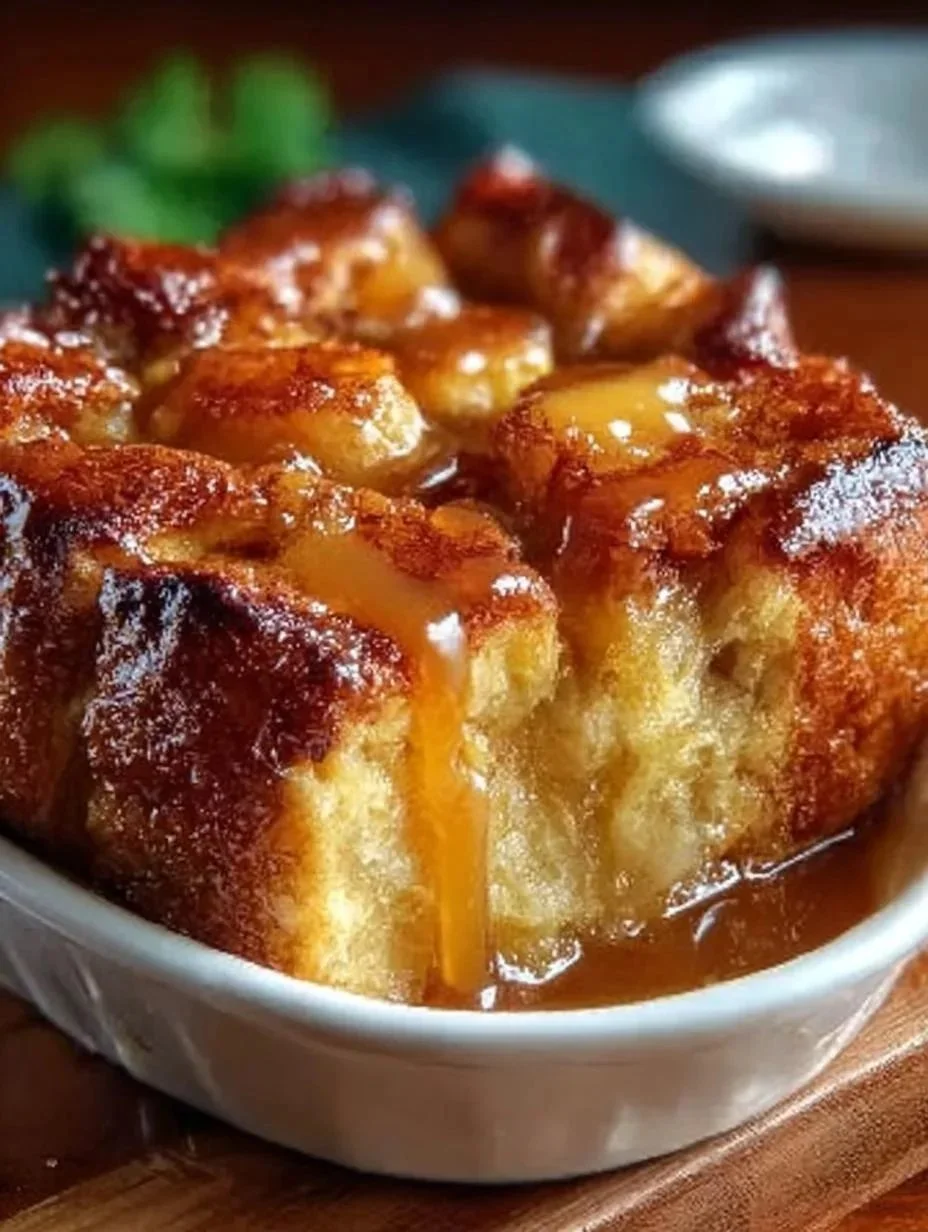
Croissant Bread Pudding with Caramel
The first bite is molten caramel, a soft custard, and flaky croissant layers that melt on your tongue. This croissant bread pudding is the easiest way to turn day-old croissants into a showstopping dessert or lazy breakfast. I refined this version over eight tests in a home kitchen and during pastry shifts at a neighborhood bistro, focusing on custard texture and a glossy caramel sauce that doesn’t sog the top. The technique is forgiving, but a few precise steps keep the custard silky and the croissant edges slightly crisp. Read on for exact measurements, timing, and tips to make this reliably excellent every time.
Why This Recipe Works
- Folding torn croissants into a warm custard lets layers partially rehydrate while preserving some flaky texture for contrast.
- A double cream-plus-milk ratio yields a custard that is rich without being gelatinous.
- Resting the assembled dish for 20–30 minutes lets croissant pieces absorb evenly and prevents dry pockets.
- Making the caramel separately and pouring it over avoids a soggy top and gives a shiny finish.
- Gentle cooking at 160°C (325°F) heats the custard through without curdling.
Read more about vanilla-infused custards for texture tips
Ingredients Breakdown
- Croissants — 600 g (about 6–8 medium croissants), torn into 3–4 cm pieces. Day-old croissants work best; very fresh croissants can collapse into mush. You can use bakery or supermarket croissants.
- Whole milk — 240 ml (1 cup). Adds structure and thins the custard for even absorption.
- Heavy cream — 360 ml (1 1/2 cups). Increases richness and gives a silky mouthfeel.
- Large eggs — 4 large (about 200 g without shells). Eggs set the custard; don’t omit them unless using a substitute below.
- Granulated sugar — 100 g (1/2 cup) in custard. Sweetness balances the caramel.
- Vanilla extract — 2 tsp (10 ml). Use pure vanilla for the best flavor.
- Kosher salt — 1/2 tsp (2.5 g). If using Morton’s, use 1/4 tsp because it is denser.
- Unsalted butter — 30 g (2 tbsp), melted, folded into custard for sheen and flavor.
- For the caramel: granulated sugar 150 g (3/4 cup), water 60 ml (1/4 cup), heavy cream 120 ml (1/2 cup), unsalted butter 30 g (2 tbsp), pinch of salt. Make this separately and pour warm over the baked pudding.
Substitutions with impact warnings:
- Swap half-and-half for heavy cream to cut richness; custard will be lighter and set firmer.
- Use 2% milk instead of whole milk — the texture will be less creamy.
- For a lower-sugar version, reduce custard sugar to 75 g (1/3 cup) but the caramel will still be sweet.
- Gluten-free croissants may produce a looser texture; expect more absorption and shorter bake time.
See our guide to comforting bread puddings for more ingredient choices
Essential Equipment
- 9 x 13-inch (23 x 33 cm) baking dish or a similar 3.5–4 quart (3.3–3.8 L) ovenproof pan. This volume prevents overflow and lets croissant pieces layer.
- Saucepan for caramel with a heavy bottom — prevents hot spots when melting sugar.
- Whisk and large mixing bowl for custard.
- Instant-read thermometer — helps check custard doneness (74°C / 165°F).
- Fine-mesh sieve (optional) — for straining custard if you want extra-smooth texture.
- Baking sheet to place under the dish to catch spills.
If you don’t have a 9 x 13 dish, use two smaller dishes and reduce baking time slightly.
Step-by-Step Instructions
Prep Time: 20 minutes • Cook Time: 45 minutes • Inactive Time: 30 minutes resting • Total Time: 1 hour 35 minutes • Servings: 6 (1 slice)
Step 1: Tear and arrange the croissants
Tear 600 g (about 6–8) croissants into 3–4 cm pieces and spread them in your greased 9 x 13-inch (23 x 33 cm) dish. Aim for an even layer so custard soaks uniformly. Let the pieces sit while you make the custard so they dry slightly, about 10 minutes.
Step 2: Make the custard
Whisk 240 ml (1 cup) whole milk, 360 ml (1 1/2 cups) heavy cream, 4 large eggs, 100 g (1/2 cup) granulated sugar, 2 tsp (10 ml) vanilla, 1/2 tsp (2.5 g) kosher salt, and 30 g (2 tbsp) melted unsalted butter until smooth. Pour a small stream of custard over the croissants, pressing lightly to submerge pieces; then pour the rest evenly. Do not overmix the torn croissants — you want distinct layers to remain.
Step 3: Rest to absorb
Let the assembled dish rest at room temperature for 20–30 minutes so the croissants soak the custard evenly. If you need to pause longer, cover and refrigerate for up to 8 hours. Resting prevents dry centers and keeps edges flaky.
Step 4: Bake gently
Preheat oven to 160°C (325°F). Place the dish on a baking sheet and bake for 40–45 minutes, until the top is puffed and pale golden and an instant-read thermometer reads 74°C (165°F) in the center. If the top browns too quickly, tent loosely with foil for the last 10 minutes.
Step 5: Make the caramel sauce
While the pudding bakes, combine 150 g (3/4 cup) granulated sugar and 60 ml (1/4 cup) water in a saucepan. Cook over medium, swirling the pan occasionally until it’s deep amber, about 8–10 minutes. Remove from heat and carefully whisk in 120 ml (1/2 cup) heavy cream and 30 g (2 tbsp) butter until smooth. Add a pinch of salt. Cool slightly; it will thicken as it cools.
Step 6: Finish and rest
When the pudding is done, remove from oven and let rest 10–15 minutes before drizzling warm caramel over the top. Resting helps the custard finish setting and keeps slices neat. Serve warm or at room temperature.
For tips on texture and serving, compare with creole-style bread puddings
Expert Tips & Pro Techniques
- Use slightly stale croissants: They hold structure better and absorb custard without collapsing.
- Common mistake: overbaking. If the center looks set but still trembles slightly, it’s fine; it will finish during resting. Overbaked custard becomes dry and rubbery.
- Professional trick adapted for home cooks: Warm the custard slightly (to about 30°C / 86°F) before pouring. This helps the croissant layers absorb evenly without shocking cold pastry.
- Make-ahead: Assemble the dish, cover, and refrigerate overnight. Bring to room temperature 30 minutes before baking and add 5–10 extra minutes to bake time.
- Caramel safety: When adding cream to hot caramel, remove from heat and add cream in a slow stream while whisking to avoid splatters.
- To serve with crisp top: Broil for 1–2 minutes after baking, watching constantly, then pour caramel after broiling.
Try banana or fruit add-ins inspired by pudding roll ideas
Storage & Reheating
- Refrigerator: Cover tightly with plastic wrap or transfer to an airtight container. Keeps 3–4 days. Reheat individual slices in the oven.
- Freezer: You can freeze baked, cooled slices in an airtight container for up to 2 months. Thaw overnight in the refrigerator.
- Reheating: Reheat at 175°C (350°F) for 10–12 minutes for a warm slice with a slightly crisp top. Warm caramel separately and drizzle after reheating. Avoid microwaving — it makes the pastry soggy.
Variations & Substitutions
- Chocolate-Caramel: Fold 100 g (3.5 oz) chopped dark chocolate into the warm custard before baking. Chocolate melts into pockets; baking time remains the same.
- Fruit & Nut: Add 150 g (1 cup) chopped apples or pears and 60 g (1/2 cup) toasted walnuts folded into croissants. Increase bake time by 5–7 minutes if fruit is extra moist.
- Lighter Version: Replace half the heavy cream with whole milk. Texture will be firmer; reduce sugar by 25 g (2 tbsp) if you prefer less sweetness.
- Egg-Free (custard-style vegan): Use a mixture of 480 ml (2 cups) coconut cream + 2 tbsp cornstarch whisked until smooth. Pour over croissant pieces and refrigerate to set rather than baking. Note: texture differs significantly.
- Single-Serve: Use a 1-cup ramekin and bake for 18–25 minutes at the same temperature.
Secondary keyword use: Try the caramel croissant pudding variation for a richer sauce.
Serving Suggestions & Pairings
- Top with lightly whipped cream and flaky sea salt for contrast.
- Pair with strong coffee or an espresso for breakfast, or a late-harvest Riesling for dessert.
- Add fresh berries or a citrus compote to cut richness.
- For brunch, serve alongside scrambled eggs and smoked salmon to balance sweet and savory flavors.
Internal pairing idea: pair with our vanilla bread pudding for a dessert flight.
Nutrition Information
Per serving (1 slice — recipe makes 6):
- Calories: 560 kcal
- Total Fat: 33 g
- Saturated Fat: 18 g
- Cholesterol: 220 mg
- Sodium: 240 mg
- Total Carbohydrates: 54 g
- Dietary Fiber: 1 g
- Sugars: 32 g
- Protein: 9 g
Nutrition values are estimates. Actual values may vary based on specific ingredients and preparation methods.
Frequently Asked Questions
Q: Why did my pudding turn out dry?
A: It was likely overbaked. Remove the pudding when the center still has a slight jiggle and an instant-read thermometer reads about 74°C (165°F). Resting finishes the set.
Q: Can I make this without eggs?
A: Yes, use a coconut-cream and cornstarch gel as a vegan alternative and chill to set. Expect a different, slightly denser texture.
Q: Can I double this recipe?
A: Yes. Use two dishes rather than one very large dish to ensure even baking. Bake times may increase 5–10 minutes.
Q: Can I prepare this the night before?
A: Absolutely. Assemble, cover, and refrigerate overnight. Bring to room temperature 30 minutes before baking and add 5–10 minutes to bake time.
Q: How long does this keep in the fridge?
A: Stored in an airtight container, it keeps 3–4 days. Reheat in a 175°C (350°F) oven for 10–12 minutes.
Q: My caramel seized when I added cream. What happened?
A: The caramel was probably too cool or the cream was added too quickly. Remove from heat and whisk slowly while adding cream in a thin stream.
Q: Can I use frozen croissants?
A: Thaw them first and dry them in a 150°C (300°F) oven for 5–7 minutes to restore flakiness before tearing and assembling.
Conclusion
This croissant bread pudding with caramel makes the most of leftover pastries and rewards minimal effort with deep flavor and glossy finish. If you’d like a similar home-style version with a different caramel approach, read this take on Croissant Bread Pudding with Caramel Sauce for inspiration. For another chef’s twist on caramel and croissant pudding, see Caramel Croissant Pudding Recipe | Nigella Lawson.
Enjoy—serve warm, and don’t skip the extra caramel drizzle.
Print
Croissant Bread Pudding with Caramel
- Total Time: 95 minutes
- Yield: 6 servings 1x
- Diet: Vegetarian
Description
A delicious and easy dessert that turns day-old croissants into a rich bread pudding topped with glossy caramel.
Ingredients
- 600 g croissants (about 6–8 medium), torn into 3–4 cm pieces
- 240 ml whole milk (1 cup)
- 360 ml heavy cream (1 1/2 cups)
- 4 large eggs (about 200 g without shells)
- 100 g granulated sugar (1/2 cup)
- 2 tsp vanilla extract (10 ml)
- 1/2 tsp kosher salt (2.5 g)
- 30 g unsalted butter, melted (2 tbsp)
- 150 g granulated sugar for caramel (3/4 cup)
- 60 ml water for caramel (1/4 cup)
- 120 ml heavy cream for caramel (1/2 cup)
- 30 g unsalted butter for caramel (2 tbsp)
- Pinch of salt for caramel
Instructions
- Tear and arrange the croissants in a greased 9 x 13-inch (23 x 33 cm) dish.
- Whisk together whole milk, heavy cream, eggs, sugar, vanilla, salt, and melted butter until smooth.
- Pour a small stream of custard over the croissants, pressing lightly to submerge pieces.
- Let the assembled dish rest at room temperature for 20–30 minutes to absorb custard.
- Preheat the oven to 160°C (325°F) and bake for 40–45 minutes until cooked through.
- Combine granulated sugar and water in a saucepan for caramel, cooking until deep amber.
- Remove from heat and whisk in heavy cream and butter until smooth.
- Rest the pudding for 10–15 minutes before drizzling with warm caramel.
Notes
For best texture, use slightly stale croissants. Store leftovers in an airtight container for up to 4 days.
- Prep Time: 20 minutes
- Cook Time: 45 minutes
- Category: Dessert
- Method: Baking
- Cuisine: French
Nutrition
- Serving Size: 1 slice
- Calories: 560
- Sugar: 32 g
- Sodium: 240 mg
- Fat: 33 g
- Saturated Fat: 18 g
- Unsaturated Fat: 8 g
- Trans Fat: 0 g
- Carbohydrates: 54 g
- Fiber: 1 g
- Protein: 9 g
- Cholesterol: 220 mg