
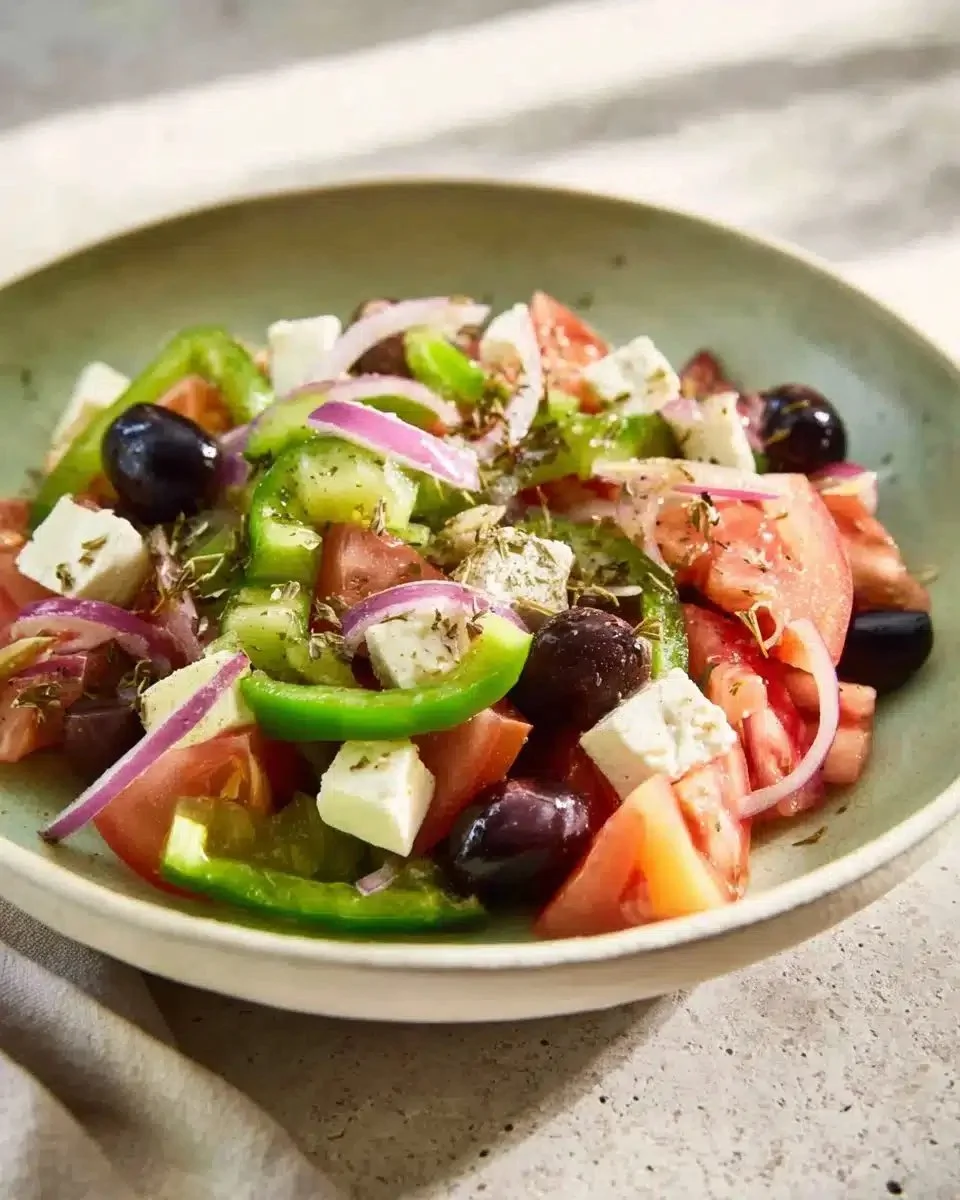
Classic Greek Salad — Easy, Bright, and Crisp
Bright, briny, and crunchy, Greek salad with homemade dressing is the summer side that never gets old. I perfected this version over dozens of summer service shifts and home tests, tweaking salt, acid, and cut size until every bite balanced. After testing this recipe 8 times with different tomatoes and blocking the dressing ingredients by weight, I settled on simple ratios that keep the vegetables crisp and the feta creamy without overpowering the salad. This recipe focuses on textural contrast: crunchy cucumber, juicy tomato, silky olive oil, and crumbly feta. Read on for why it works, precise ingredient notes, and step-by-step technique so you get a perfect bowl every time.
Why This Recipe Works
- Acid-to-oil balance: A 1:2 vinegar-to-oil ratio (plus a dash of lemon) brightens without making the oil heavy. That keeps flavors sharp and clean.
- Large, chunky cuts: Medium dice prevents the salad from turning to slush while offering contrast to the creamy feta.
- Salt timing: Salting the vegetables lightly up front draws out excess water and concentrates flavor without making the salad soggy.
- Simple emulsification: A quick whisk or jar shake creates a stable dressing that clings to vegetables rather than pooling.
- Resting briefly: Letting the dressed salad sit 5–10 minutes melds flavors while keeping texture intact.
Ingredients Breakdown
- Tomatoes — 400 g (3 medium) ripe tomatoes, cut into 2–3 cm (¾–1") wedges. Use vine-ripened or plum tomatoes. Overly watery tomatoes will dilute the dressing.
- Cucumbers — 300 g (2 cups) cucumber, halved lengthwise and sliced 1 cm (½") thick. Persian cucumbers work well. If using English cucumbers, leave the skin on for crunch.
- Red onion — 50 g (½ small), thinly sliced into half-moons. If raw onion is sharp, soak slices in cold water 5 minutes and drain.
- Kalamata olives — 120 g (1 cup) pitted. These add briny depth. If you can only find whole olives, pit them carefully or buy pre-pitted.
- Feta cheese — 200 g (7 oz) block, cut into 1 cm (½") cubes or crumbled. Block feta holds texture better than pre-crumbled.
- Fresh oregano — 1 tbsp (about 2 g), chopped, or 1 tsp dried oregano. Oregano is the aromatic backbone.
- Kosher salt — 1 tsp (6 g) Diamond Crystal; if using Morton’s, use ½ tsp (3 g) because it’s denser. Diamond Crystal is recommended for volume measurements.
- Black pepper — freshly ground, to taste.
Dressing
- Extra-virgin olive oil — 60 ml (¼ cup). Use a fruity, fresh olive oil you enjoy.
- Red wine vinegar — 30 ml (2 tbsp).
- Lemon juice — 15 ml (1 tbsp), freshly squeezed.
- Garlic — 1 small clove (about 3 g), minced.
- Dijon mustard — 5 ml (1 tsp). Helps emulsify the dressing.
- Dried oregano — 1 tsp (1 g).
- Salt — ¼–½ tsp (1–3 g), adjust to taste.
- Honey or sugar — optional 1 tsp (5 g) to round harsh acids if needed.
Substitutions with impact warnings:
- Feta swap: Use a firm, block-style vegan feta for a dairy-free option; texture will be firmer and salt level may differ.
- Olive oil: Do not substitute a neutral oil for extra-virgin olive oil — the fruity note is important.
- Vinegar swap: White wine vinegar is milder; you may need an extra ½ tbsp to match brightness.
Essential Equipment
- Large mixing bowl (3–4 L): Big enough to toss without bruising ingredients.
- Chef’s knife and cutting board: Sharp knife for clean cuts.
- Digital scale: For precise vegetable and feta weights.
- Measuring spoons and cups: For dressing accuracy.
- Small bowl and whisk OR a 500 ml jar with lid: For emulsifying the dressing quickly.
- Salad tongs or two large spoons: For gentle tossing.
- Optional: Mandoline for uniform cucumber slices — use the guard, or substitute a sharp knife.
If you don’t have a scale, use the cup equivalents listed above. A jar with a lid is a perfect dressing tool if you don’t want to whisk.
Try a bright fruit salad alongside this for a summer spread.
Step-by-Step Instructions
Makes 4 servings. Prep time 15 minutes. Cook time 0 minutes. Inactive time 5–10 minutes resting after dressing. Total time about 20–25 minutes.
Step 1: Prepare and salt the vegetables
Trim and halve 300 g (2 cups) cucumbers and slice 1 cm (½") thick; quarter 400 g (3 medium) tomatoes into wedges; thinly slice 50 g (½ small) red onion. Lightly toss cucumbers and tomatoes with ½ tsp (3 g) kosher salt and let sit 5 minutes to draw out excess moisture, then gently pat dry with a paper towel. This concentrates flavor and prevents a watery salad.
Step 2: Make the dressing
In a small bowl or a 500 ml jar, combine 60 ml (¼ cup) extra-virgin olive oil, 30 ml (2 tbsp) red wine vinegar, 15 ml (1 tbsp) lemon juice, 1 minced garlic clove (3 g), 5 ml (1 tsp) Dijon, 1 tsp (1 g) dried oregano, and ¼–½ tsp salt (1–3 g). Whisk vigorously for 20 seconds or shake the jar for 10 seconds until the mixture emulsifies and slightly thickens. Taste and adjust — add 1 tsp (5 g) honey if the dressing is too sharp.
Step 3: Cut the feta and prep olives
Cut 200 g (7 oz) block feta into 1 cm (½") cubes or crumble by hand for a rustic texture. Pit and halve 120 g (1 cup) Kalamata olives if necessary. Keeping feta in chunks helps it remain distinct when tossed.
Step 4: Assemble the salad
In a large bowl, combine the drained cucumbers, tomatoes, 120 g (1 cup) olives, and 1 tbsp (2 g) minced fresh oregano. Pour dressing over the vegetables and toss gently with salad tongs until everything is evenly coated, about 10–15 seconds of tossing. Be gentle — don’t over-toss or you’ll break up the tomatoes.
Step 5: Add feta and finish
Nestle the feta cubes on top and give the salad one gentle lift to distribute. Finish with a few grinds of black pepper and a final drizzle of olive oil if desired. Let the salad sit 5–10 minutes at room temperature for flavors to mingle before serving.
Step 6: Serve immediately
Transfer to a serving bowl and garnish with whole oregano leaves or a lemon wedge. This salad is best served the day you make it; textures are at their peak within the first hour.
Expert Tips & Pro Techniques
- Common mistake and fix: If your salad is watery, you salted the vegetables too early or used overripe tomatoes. Salt lightly and pat dry after 5 minutes to avoid sogginess.
- Make-ahead: Prep vegetables and dressing up to 24 hours ahead; store vegetables and dressing separately. Combine and rest 5–10 minutes before serving.
- Professional technique for home cooks: Salt vegetables first and let them rest; then put them on a rack to drain into a bowl. This concentrates flavors without losing texture.
- Knife skills tip: Cut tomatoes into wedges rather than small dice to keep juices locked in pieces, preventing the bowl from becoming soupy.
- Flake oil finish: For a restaurant touch, finish with a tiny splash (around 5 ml / 1 tsp) of the best extra-virgin olive oil just before serving.
- Avoid bottled dressing trap: Bottled vinaigrettes are often emulsified with stabilizers and can coat rather than marry with the vegetables; homemade dressing clings and tastes fresher.
Storage & Reheating
- Refrigerator: Store leftover salad in an airtight container for up to 24–48 hours; the vegetables will soften over time. If you expect leftovers, store vegetables and dressing separately for up to 48 hours.
- Freezer: This salad does not freeze well. Feta and olives can survive freezing, but cucumbers and tomatoes will become mushy on thawing.
- Reheating: Do not reheat. Serve cold or at room temperature. If the salad has been refrigerated, let it sit 10–15 minutes to lose chill before serving so flavors open up.
Variations & Substitutions
- Vegan Version: Replace 200 g (7 oz) feta with 200 g (7 oz) firm tofu, pressed and cubed, and add ¼ tsp extra salt to the dressing. Use a vegan feta for closer flavor. Texture and salt may be milder; adjust to taste.
- Grain Bowl Variation: Keep vegetables and dressing the same. Add 240 g (2 cups) cooked farro or quinoa to transform into a hearty bowl — toss warm grain with dressing so it absorbs flavor.
- Low-Sodium: Use low-sodium feta and reduce kosher salt to ¼ tsp (1 g). Increase lemon juice by ½ tbsp to maintain brightness.
- Mediterranean Mix: Add 150 g (1 cup) cooked chickpeas for protein — toss chickpeas with the dressing for at least 10 minutes to let them absorb flavor. This keeps the salad filling while preserving classic taste.
- Herb-forward: Swap oregano for 1 tbsp chopped fresh mint and 1 tbsp parsley for a fresher, green profile. Keep dressing and amounts the same.
Try Greek potatoes as a warm side with this salad for a classic combo.
Serving Suggestions & Pairings
- Main-course pairing: Grill a lemon-herb chicken breast and serve alongside the salad for a light, balanced meal.
- Vegetable sides: A plate of roasted vegetables or our Refreshing Chickpea Salad pairs well for a vegetarian spread.
- Breads and dips: Serve with warm pita and a small bowl of tzatziki to complement the salty feta.
- Light dessert: Finish the meal with a fruit-forward dessert such as spinach-strawberry salad for contrast.
Nutrition Information
Serving size: about 1 cup (serves 4)
Per serving (estimate):
- Calories: 320 kcal
- Total Fat: 26 g
- Saturated Fat: 8 g
- Cholesterol: 25 mg
- Sodium: 640 mg
- Total Carbohydrates: 10 g
- Dietary Fiber: 2 g
- Sugars: 5 g
- Protein: 7 g
Nutrition values are estimates. Actual values may vary based on specific ingredients and preparation methods.
Frequently Asked Questions
Q: Why did my salad turn out soggy?
A: Overripe tomatoes or salting too early cause sogginess. Salt vegetables briefly (about 5 minutes) and pat dry. Use firmer tomatoes and keep cut sizes larger to retain texture.
Q: Can I make this without eggs?
A: Yes — the recipe contains no eggs. The dressing is an oil-vinegar emulsion stabilized with mustard, so it’s naturally egg-free.
Q: Can I double this recipe?
A: Yes. Double all ingredient amounts and use a bowl at least twice as large. Mix dressing in a jar or pitcher and taste for seasoning after combining — you may need a touch more salt for larger batches.
Q: Can I prepare this the night before?
A: Prep vegetables and dressing separately up to 24 hours ahead. Combine just before serving and let the salad rest 5–10 minutes to meld flavors.
Q: How long does this keep in the fridge?
A: When dressed, keep in an airtight container for 24–48 hours. For best texture, store salad components separately and combine within 48 hours.
Q: Can I use bottled dressing?
A: You can, but bottled dressings often contain stabilizers and sweeteners that change the flavor balance. Homemade dressing is quick and lets you control acid and salt.
Q: What’s the best way to crumble feta?
A: Use a fork to gently press into a block for irregular pieces. If you want uniform cubes, slice the block with a sharp knife into 1 cm (½") pieces.
Conclusion
This Greek salad sings when you balance bright acid, fruity oil, and measured salt. For a slightly different dressing approach and inspiration, see this Greek Salad Dressing Recipe – Love and Lemons, and for a quick, simple five-ingredient variation try the 5-Ingredient Greek Salad Dressing Recipe – Alexandra’s Kitchen. Enjoy the contrast of textures and the ease of a salad that comes together in minutes.
Print
Classic Greek Salad
- Total Time: 20 minutes
- Yield: 4 servings 1x
- Diet: Vegetarian
Description
A bright, briny, and crunchy Greek salad with homemade dressing, focusing on textural contrasts for a perfect summer side.
Ingredients
- 400 g ripe tomatoes, cut into wedges
- 300 g cucumber, halved and sliced
- 50 g red onion, thinly sliced
- 120 g Kalamata olives, pitted
- 200 g feta cheese, cubed or crumbled
- 1 tbsp fresh oregano, chopped
- 1 tsp kosher salt
- Freshly ground black pepper, to taste
- Dressing:
- 60 ml extra-virgin olive oil
- 30 ml red wine vinegar
- 15 ml lemon juice
- 1 small clove garlic, minced
- 5 ml Dijon mustard
- 1 tsp dried oregano
- ¼–½ tsp salt, to taste
- 1 tsp honey or sugar, optional
Instructions
- Prepare and salt the vegetables: Cut cucumbers, tomatoes, and red onion. Toss with salt and let sit for 5 minutes.
- Make the dressing: Combine all dressing ingredients and whisk or shake until emulsified.
- Cut the feta and olives: Cube or crumble feta and prepare olives if necessary.
- Assemble the salad: Combine vegetables in a large bowl, dress with the prepared dressing, and toss gently.
- Add feta and finish: Nestle feta on top, sprinkle with pepper, and let sit for 5–10 minutes before serving.
- Serve immediately: Transfer to a serving bowl and garnish as desired.
Notes
Best served fresh; store leftovers separately to maintain texture.
- Prep Time: 15 minutes
- Cook Time: 0 minutes
- Category: Salad
- Method: Mixing
- Cuisine: Greek
Nutrition
- Serving Size: 1 serving
- Calories: 320
- Sugar: 5g
- Sodium: 640mg
- Fat: 26g
- Saturated Fat: 8g
- Unsaturated Fat: 12g
- Trans Fat: 0g
- Carbohydrates: 10g
- Fiber: 2g
- Protein: 7g
- Cholesterol: 25mg